
Why Zipper Sliders Fail: Wire Quality as the Root Cause
A slider that jams, drags or refuses to close is usually replaced. When the same complaint returns on the next order, the slider was rarely the variable that moved — the track it runs on was.
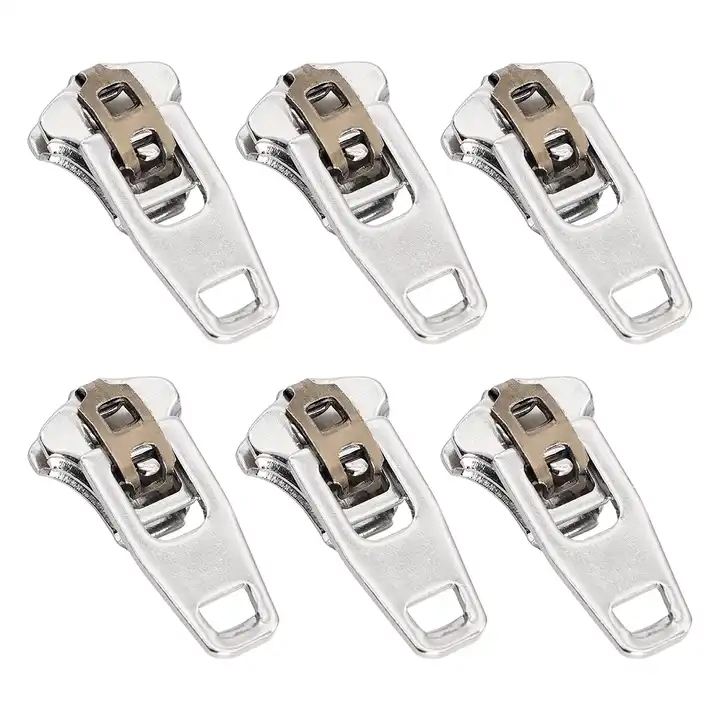
A zipper slider is a fixed-geometry part. It gauges a chain built from hundreds of sequentially formed wire elements, and it does so with one internal clearance that cannot adjust itself. When the cross-section, hardness or size of those elements drifts, the slider behaves exactly as a defective slider would: it catches, it floats, it opens behind the pull.
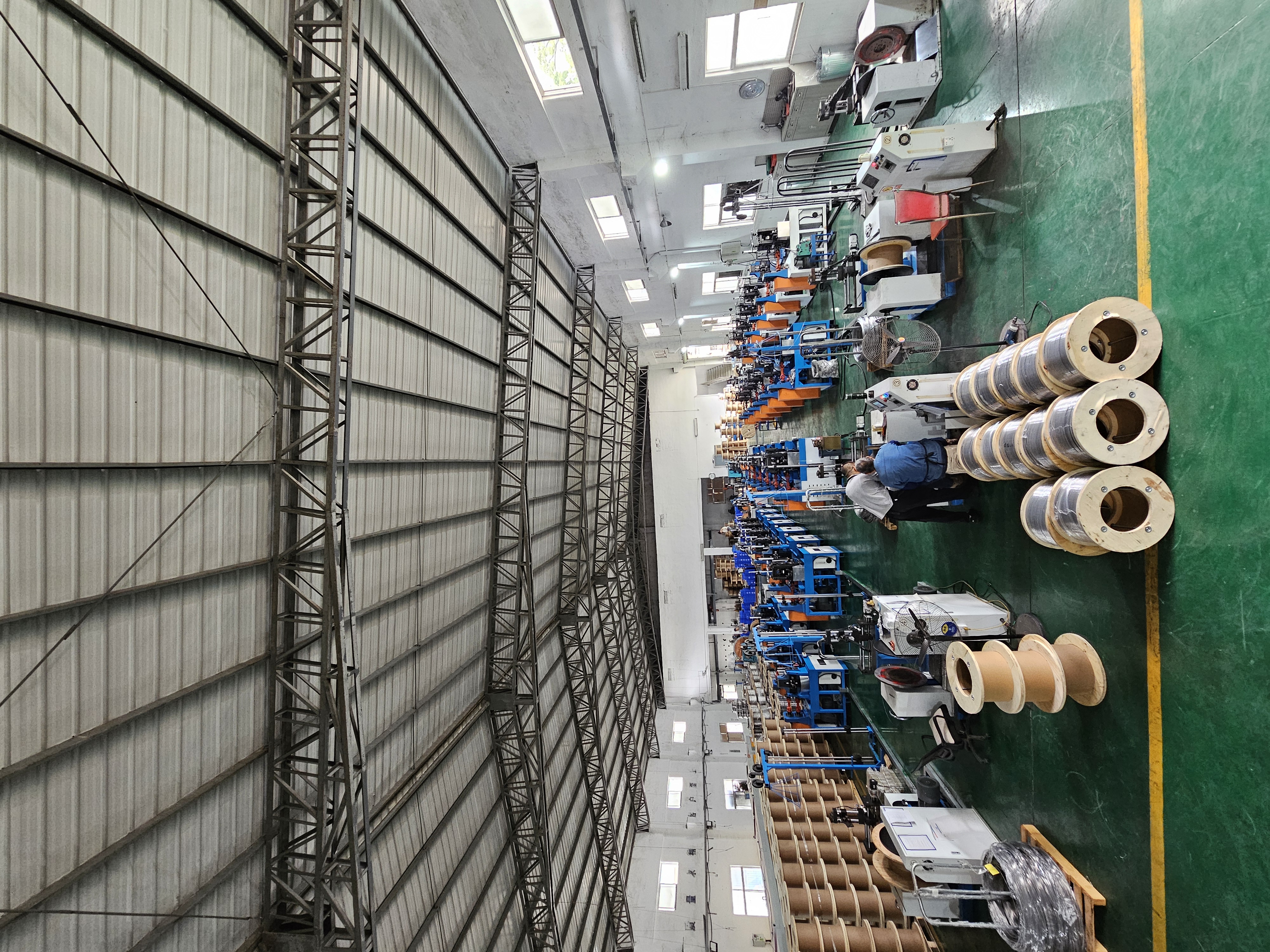
This article works the problem from the wire side. It defines what “slider failure” actually describes, explains why wire consistency has become harder to hold as materials shift, and shows where the published parameters of Fullgreat’s Y Teeth Wire (FPD-YTW01), Profiled Wire (FPD-PW) and Zipper Automatic Slider (FPD-ZAS) fit into a corrective action. Fullgreat Metal Limited is a Shenzhen-based manufacturer of non-magnetic stainless steel strip and wire, aluminum strip and zipper metal wire components, founded in 2008.
Problem Definition: What “slider failure” actually describes
“Slider failure” is a symptom label, not a diagnosis. On a production line it usually refers to one of four conditions:
- Hard pull or hard start. The pull needs noticeably more force than the approved reference sample, from the first tooth onward.
- Tight spots. Glide is uneven along the chain: a section runs freely, then binds, then runs freely again.
- Self-opening. The chain separates behind the slider after it has closed, without the pull being actuated.
- End-of-chain release. The slider leaves the track at the top or bottom stop, or the stop itself deforms.
Only the first of these is unambiguously a slider-body condition. The other three can be produced by the track — by tooth thickness, groove depth, hardness and surface condition — without the slider being out of specification at all. That distinction decides who receives the corrective action request. If a buyer replaces the slider supplier and the complaint persists, the slider was never the constraint.
The definition also changes what should be measured first. A slider is checked against its own drawing: channel width, height, spring position. A track is checked against a distribution across hundreds of elements. When the failure is intermittent, the distribution is almost always the better place to start.
Why the wire usually sets the outcome, not the slider
Three properties of zipper construction make the wire the dominant variable in glide performance.
- Variance accumulates. A slider gauges one clearance; a finished zipper presents that clearance with hundreds of teeth and two stop positions. A small systematic deviation in tooth thickness repeats across the entire chain instead of averaging out.
- The slider cannot compensate. Unlike a garment seam allowance, a slider channel has no take-up. If groove depth or tooth thickness sits above the nominal band for a full lot, every slider in that lot will feel it.
- Hardness is an interface, not a property. Teeth hardness and slider-body hardness interact. Specify one as hard and the other as soft and the interface between them is undefined, even though each component individually meets its own drawing.
Surface condition belongs in the same list. Burrs, laps and rough edges on a formed tooth are contact points inside the slider channel. Fullgreat’s zipper OEM case record lists a smooth finished product free of burrs as a key quality highlight, alongside stable operation across the project — which is exactly the expected pairing when the track is held constant.
Industry Background: why wire consistency became harder to hold
The material mix in zipper manufacturing has broadened. Brass is no longer the default reference point for every programme, and stainless steel, aluminum and composite constructions now sit alongside it. Fullgreat’s own published data positions bimetallic composite wires, such as copper clad stainless steel, as able to reduce raw material costs by 30% to 40% compared with solid brass.
That shift is commercially attractive and technically demanding at the same time. Every substitution changes the behaviour of the formed element, and the number of variables a buyer has to pin down in a purchase order grows with it: material route, cross-sectional profile, size code, and hardness. A specification that once read “brass Y-teeth wire, size #5” now needs several more fields before it is reproducible.
A second pressure comes from portfolio breadth. A zipper component programme typically spans special-shaped wire, shaped wire, profiled wire, metal round wire, round wire, flat wire, spring wire, top stop, bottom stop, zipper puller, zipper automatic slider, Y-shape wire for zipper, Y teeth wire and Y teeth. When wire and slider are bought from different sources, the hardness and tolerance assumptions between them are rarely written down anywhere. The complaint surfaces later, at the sewing line or at final inspection.
Detailed Solution: specifying track and slider as one system
The corrective logic is straightforward: treat the wire that forms the track and the slider that gauges it as one specification, with material and hardness defined on both sides. Fullgreat publishes the parameters needed to do this without relying on assumptions.
Y Teeth Wire (FPD-YTW01): where track consistency is created
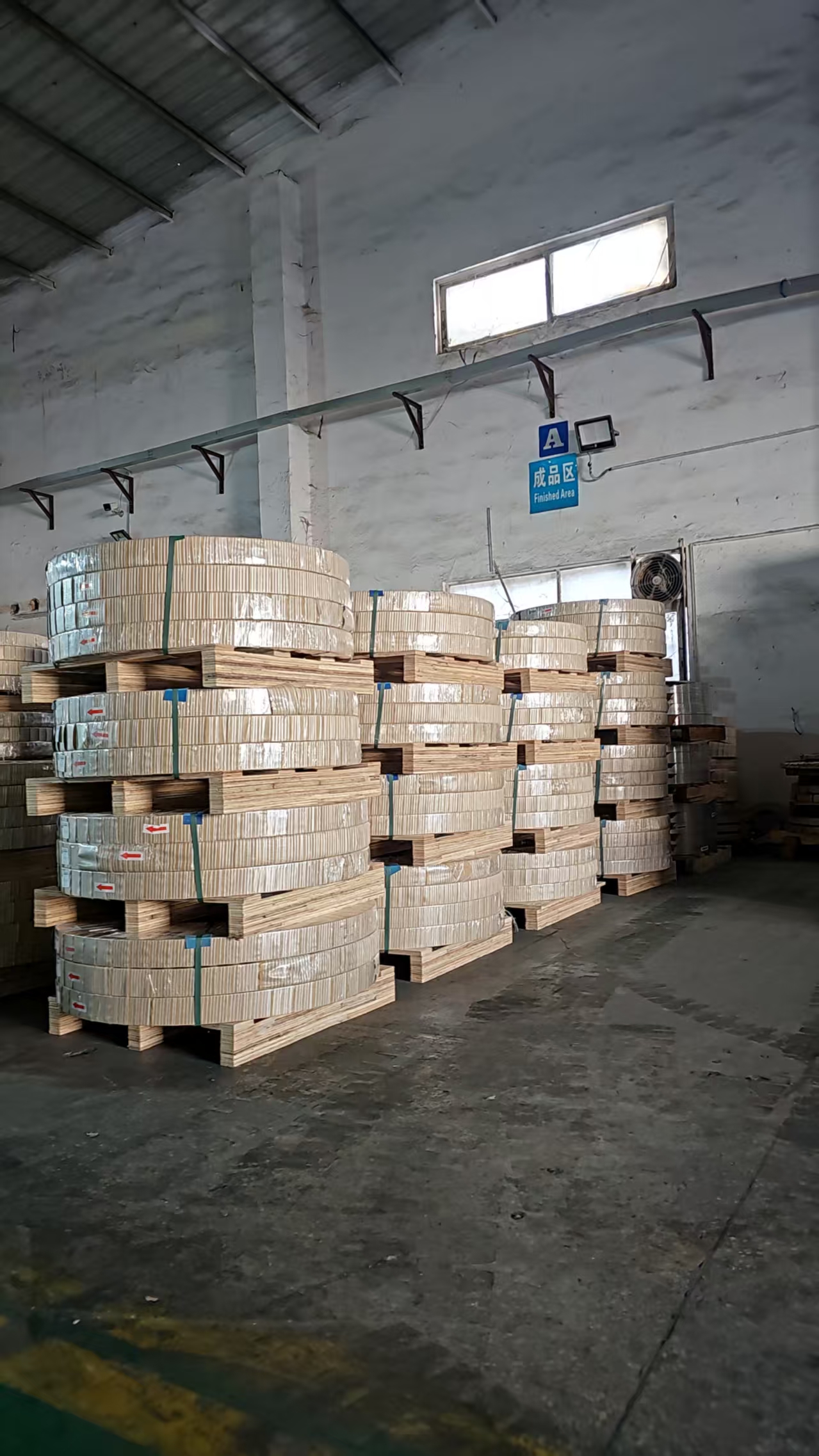
Y Teeth Wire is the component that forms the tooth chain. In Fullgreat’s published parameters, shape, size, material and hardness are all customizable, and the material set is stainless steel, copper or aluminum with hardness selectable as soft or hard. The stated application scope is clothing accessories and bag & luggage.
The number that matters most in a slider-failure investigation is the dimensional tolerance. Fullgreat publishes a tolerance of ±0.01 mm for preformed Y-teeth zipper wire, applied to cross-sectional width, tooth thickness and groove depth, together with uniform tensile elongation. Those are precisely the features that define how much clearance the slider channel has to pass: groove depth and tooth thickness set the working fit, and elongation consistency keeps the formed profile stable along the chain rather than drifting between coils.
The same tolerance statement covers the #3, #4, #5 and #8 Y-teeth profiles. Fullgreat’s Zipper Metal Wire (FPD-ZMW) parameter set lists size as customized #3, #4 and #5, with material and hardness also customizable.

Profiled Wire (FPD-PW): shapes beyond the standard tooth
Profiled Wire covers non-standard cross-sections. Fullgreat publishes shape, size and material as customizable for this model, with stainless steel, copper and aluminum as the material options, and lists electronic accessories, home appliances, medical devices and clothing accessories as application areas.
For slider troubleshooting, profiled wire matters where the component being formed is not a standard Y tooth — for example where a custom profile sits inside the same assembly and its own dimensional drift shows up as drag at a specific point in the chain. Because the shape is customized rather than catalogue-defined, the drawing and the tolerance band have to travel with the order.
Zipper Automatic Slider (FPD-ZAS): the same material set, separately specified hardness
Zipper Automatic Slider is published with customizable shape, size, material and hardness, material options of stainless steel, copper or aluminum, and application scope in clothing accessories and bag & luggage. The Zipper Pull (FPD-ZP) carries the same four customizable fields.
The relevant point is that slider and wire share a material vocabulary. A buyer can therefore state the pairing explicitly in one document — for example, a hard-hardness stainless steel Y Teeth Wire running against a hard-hardness stainless steel automatic slider — instead of leaving the interface to be inferred. Where a softer feel is required, hardness on both components can be specified as soft, again as a pair rather than as a single line item.
Five wire specification priorities, ranked
The sequence below is an evaluation order, not a measured performance ranking. It reflects how much of the slider’s working clearance each attribute can move, and therefore how much diagnostic value it carries when a complaint is opened.
- Cross-sectional tolerance of the tooth or profile wire. This sits first because it acts on every tooth in the chain. Where the cross-section drifts, tooth thickness and groove depth drift with it, and the slider channel either pinches or floats. Fullgreat publishes ±0.01 mm on cross-sectional micro-geometry for preformed Y-teeth wire.
- Hardness pairing between wire and slider body. Both sides are customizable as soft or hard. Specifying one without the other leaves the contact interface undefined, and the symptom will look identical to a tolerance problem.
- Material route. Stainless steel, copper and aluminum behave differently as formed elements, and Fullgreat publishes the same three-option set for wire and for slider components. Choosing the material fixes the reference behaviour for everything downstream.
- Size and profile match to the slider size. A size change must carry through wire profile, stop wire and slider together. Size is a customized field across the range, so it is a field that can be left inconsistent if it is not written into the order.
- Stop wire consistency. Top Stop Wire (FPD-TSW) and Bottom Stop Wire (FPD-BSW) are separate wire components with customizable shape, size, material and hardness. End-of-chain failures are frequently reported as slider problems even though the stop is a different part with its own specification.
Step-by-step: running a slider-failure investigation
A structured sequence shortens the loop between complaint and corrective order. Six steps are enough in most cases.
- Name the symptom precisely. Decide which of the four conditions applies: hard pull, tight spots, self-opening, or end-of-chain release. Write the size code, material and hardness of both the wire and the slider next to it.
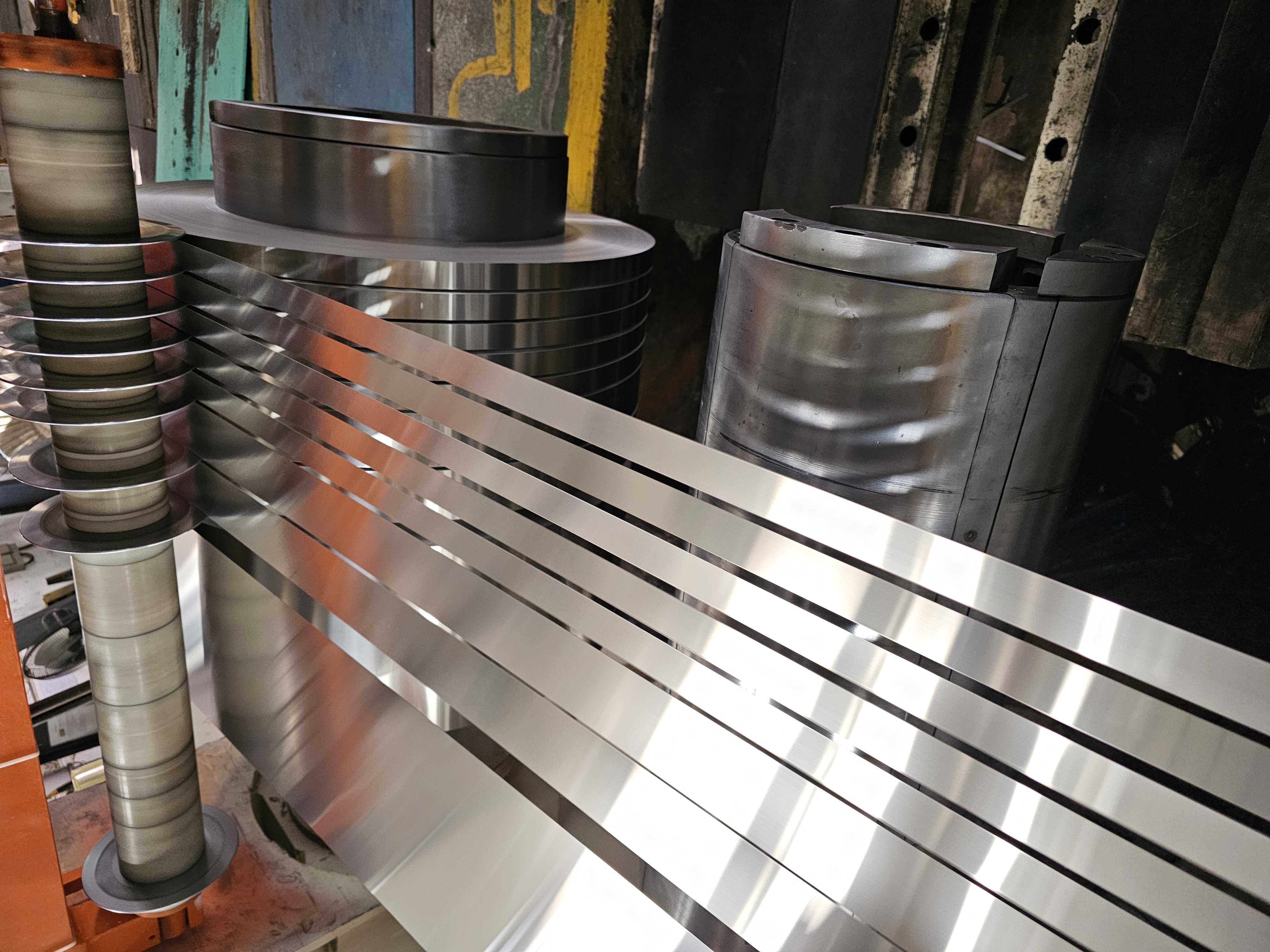
- Measure the wire, not only the slider. Fullgreat’s stated quality control covers dimensional requirements, composition, tensile strength and elongation. Cross-sectional measurement on a sample from the same lot as the failing zippers is the single most informative check.
- Check the hardness pairing. Compare the hardness specified for the teeth wire against the hardness specified for the slider body. If one was specified and the other was not, the interface is undefined and should be treated as the leading suspect.
- Confirm the material route and composition. Stainless steel, copper and aluminum are separate routes. Confirm which one the failing lot actually used, and confirm it is the same one the slider was qualified against.
- Re-run with a controlled lot. Hold material, hardness, profile and size fixed, and change one variable. Fullgreat documents a test report within its after-sales documentation, which gives the evaluation a written basis rather than a subjective glide assessment.
- Lock the specification into the purchase order. Fullgreat runs OEM/ODM production with customization in material, packaging, specifications and color, a minimum order quantity of 1 ton and a lead time of 30–45 days. Those fields should appear on the order, not only in the email trail.
Use cases: where slider complaints actually come from
Apparel programmes
Garment zippers combine a light construction with high visual expectations, and both wire and slider are available in stainless steel, copper or aluminum with soft or hard hardness. In apparel reviews, the useful discipline is to confirm that wire and slider were drawn from the same material and hardness decision — a light component specified against a hard counterpart is a pairing question, not a slider defect.
Luggage and bags
Bag and luggage applications put the track under repeated load and frequent cycling, and both Y Teeth Wire and Zipper Automatic Slider are published for this scope. Here the ranked priorities apply in the same order, but with more weight on hardness pairing and on stop wire consistency, because the ends of the chain take the impact of every open and close.
Zipper OEM production: a documented reference
Fullgreat’s case record for a Japanese zipper OEM describes a two-year programme at 50 tons per month. The recorded result is stable operation, and the recorded quality highlight is a finished product that is smooth and free of burrs. Set against the failure modes above, that combination is what a controlled track looks like: no intermittent binding to report, no burr contact points inside the slider channel.
Adjacent applications
Profiled Wire and Special-Shaped Wire extend beyond zipper components into electronic accessories, home appliances and medical devices, with shape, size and material customized. The same principle carries over: a forming process that grips, slides or locates a wire is only as repeatable as the wire cross-section feeding it.
Comparison table: wire and slider components side by side
All entries below are taken from Fullgreat’s published product parameters. Hardness is shown where the published parameter set states it.
| Component | Model | Material options | Hardness | Customization fields | Function in slider performance |
|---|---|---|---|---|---|
| Y Teeth Wire | FPD-YTW01 | Stainless steel / copper / aluminum | Soft or hard | Shape, size, material, hardness | Forms the tooth chain the slider gauges |
| Profiled Wire | FPD-PW | Stainless steel / copper / aluminum | Not stated in published parameters | Shape, size, material | Non-standard cross-sections used in custom assemblies |
| Y-shape Wire for Zipper | FPD-YSW | Stainless steel / copper / aluminum | Soft or hard | Shape, size, material, hardness | Y-profile wire for zipper chain forming |
| Zipper Automatic Slider | FPD-ZAS | Stainless steel / copper / aluminum | Soft or hard | Shape, size, material, hardness | The gauging part that runs the track |
| Zipper Pull | FPD-ZP | Stainless steel / copper / aluminum | Soft or hard | Shape, size, material, hardness | Pull attachment; not a track component |
| Top Stop Wire | FPD-TSW | Stainless steel / copper / aluminum | Soft or hard | Shape, size, material, hardness | Upper end-of-chain stop |
| Bottom Stop Wire | FPD-BSW | Stainless steel / copper / aluminum | Soft or hard | Shape, size, material, hardness | Lower end-of-chain stop |
| Spring Wire | FPD-SW02 | Stainless steel / copper / aluminum | Soft or hard | Shape (round), size, hardness | Spring element; not a track component |
Source: Fullgreat Metal Limited product parameter data. Fields not listed in the published parameter set are shown as such rather than assumed.
Diagnosis reference: symptom to first check
| Reported symptom | First wire attribute to check | Component to review |
|---|---|---|
| Hard pull from the first tooth | Cross-sectional tolerance: tooth thickness and groove depth | Y Teeth Wire (FPD-YTW01) |
| Tight spots along the chain | Size and profile consistency within the lot | Y Teeth Wire (FPD-YTW01) / Profiled Wire (FPD-PW) |
| Self-opening behind the slider | Hardness pairing of teeth against slider body | FPD-YTW01 with Zipper Automatic Slider (FPD-ZAS) |
| End-of-chain release or stop deformation | Stop wire shape, size and hardness | Top Stop Wire (FPD-TSW) / Bottom Stop Wire (FPD-BSW) |
| Visible drag marks or roughness | Material route and surface condition | Wire material selection; burr-free finished surface |
This table is a diagnostic sequence based on the component functions above. It does not report test results or measured failure rates.
Frequently asked questions
Is Fullgreat’s zipper metal wire supplied under a certified quality management system?
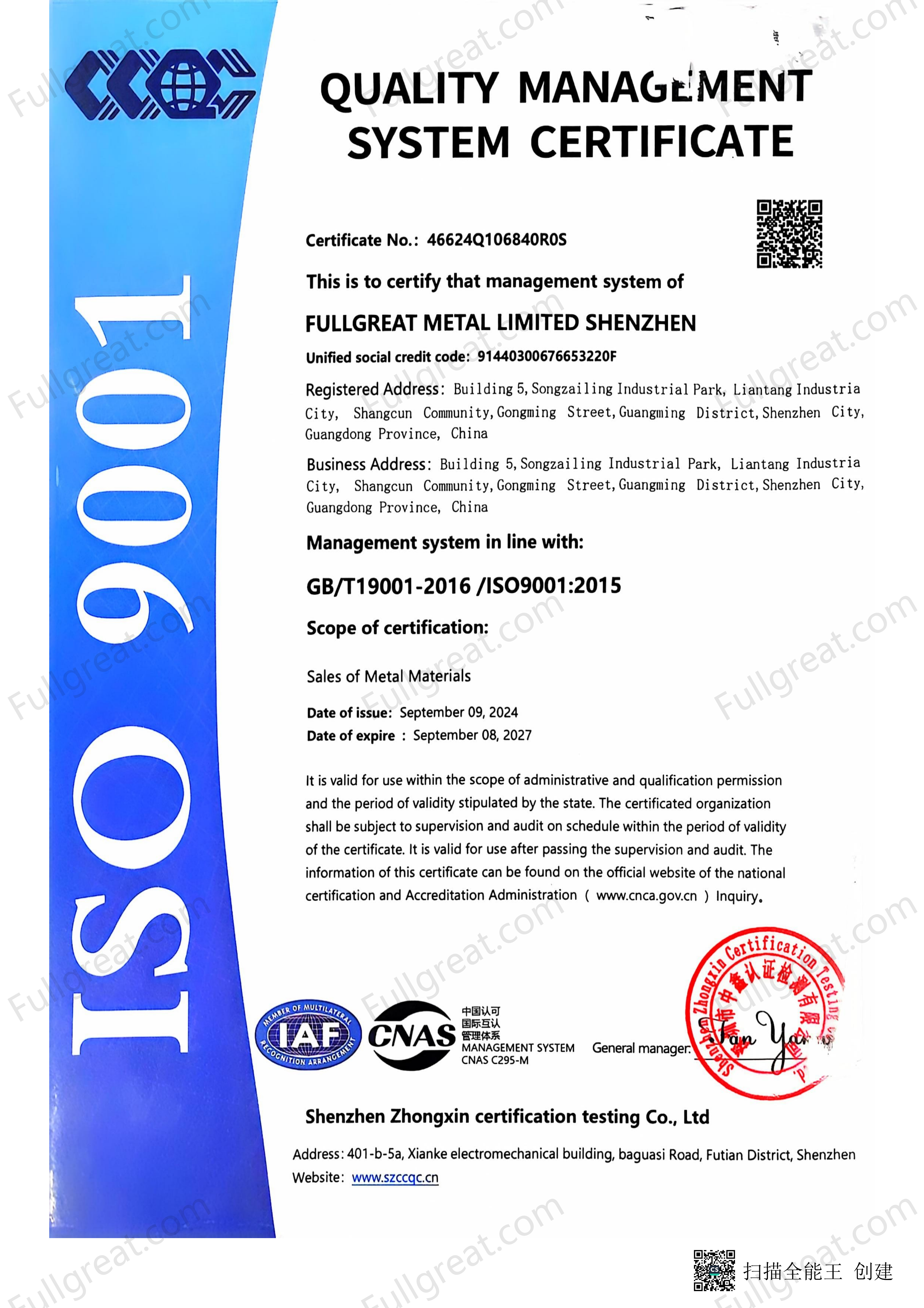
Fullgreat Metal Limited holds ISO 9001 certification, certificate number 46624Q106840R0S, issued by Shenzhen Zhongxin certification testing Co., Ltd against GB/T 19001-2016 / ISO 9001:2015. The certificate is valid from 9 September 2024 to 8 September 2027, and the certified scope stated on it is Sales of Metal Materials.
Can wire hardness be matched to a specific slider specification?
Yes. Both sides of the interface are customizable. Y Teeth Wire (FPD-YTW01) is published with customizable shape, size, material and hardness, and Zipper Automatic Slider (FPD-ZAS) carries the same four customizable fields. Material options for both are stainless steel, copper or aluminum, and hardness can be specified as soft or hard.
What order size and lead time apply to a corrective wire order?
Fullgreat states a minimum order quantity of 1 ton and a lead time of 30–45 days under an OEM/ODM production model, with customization available in material, packaging, specifications and color. Order terms are quoted per specification rather than published as a fixed price list.
How is wire verified before and after a production order?
Fullgreat’s stated quality control covers dimensional requirements, composition, tensile strength and elongation, and its after-sales documentation includes a test report. For preformed Y-teeth zipper wire, the published dimensional tolerance is ±0.01 mm on cross-sectional width, tooth thickness and groove depth, with uniform tensile elongation.
How do we start a slider-failure investigation with Fullgreat?
Send the slider model, the wire profile, the size code, the material and the hardness currently specified, together with the symptom you are seeing. Requests go to Bruce at Bruce@fullgreat.com or WhatsApp +86 13556896920, and the company profile can be downloaded here: Fullgreat Metal Company Profile (PDF).
Conclusion: fix the track, and most slider complaints close themselves
Slider failure is usually a measurement problem before it is a component problem. A slider is a fixed gauge; the track is a distribution of hundreds of formed wire elements plus two stops. When the distribution is held — cross-section, hardness, material and size — the slider has something consistent to gauge, and the symptoms that looked like slider defects stop recurring.
Fullgreat Metal Limited manufactures both sides of that interface: Y Teeth Wire (FPD-YTW01), Profiled Wire (FPD-PW), Y-shape Wire for Zipper (FPD-YSW), Top Stop Wire (FPD-TSW), Bottom Stop Wire (FPD-BSW), Zipper Pull (FPD-ZP) and Zipper Automatic Slider (FPD-ZAS), each with customizable shape, size, material and hardness where published, produced under ISO 9001 certification with a stated annual output of 50,000 tons and export coverage across Turkey, Latin America, Southeast Asia and the European and American markets.
The next step is a specification review, not a supplier change. Send the failing slider model, the wire profile and the hardness currently specified, and Fullgreat can quote against a completed specification sheet.
Request a wire and slider specification review
Share your slider model, wire profile, size code, material and hardness targets. Fullgreat Metal Limited will respond with a matching specification and quotation.
Email:Bruce@fullgreat.com | WhatsApp:+86 13556896920 | Website:www.fullgreat.com
Have Questions or Need More Details?
Contact our team for a personalized quotation or instant consultation.
Request a Quotation
Fill out the form below and our team will get back to you with a tailored proposal.
WhatsApp Direct Chat
Prefer to chat in real-time? Message us on WhatsApp for instant assistance & quick answers.
- Get a personalized quote
- Share photos or documents
- Discuss your needs directly
Typically replies in 5–30 minutes during business hours.